

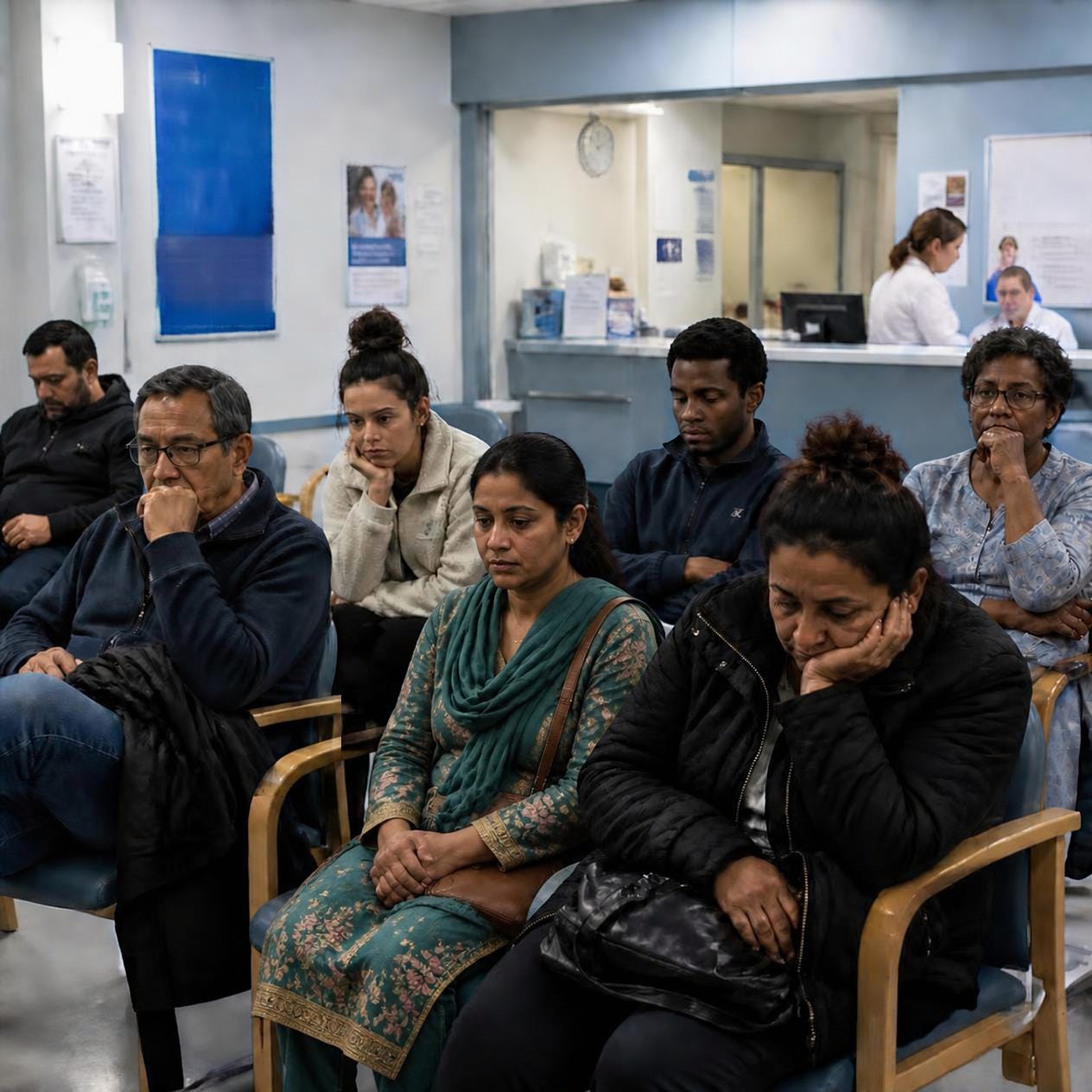
Life is often about patience. Few things come to us immediately. Some things never do.
As humans, we are a patient race. We don’t like being patient, but we recognise that it is something required of us, and to descend into impatience seldom improves things.
Enter the world of A&E - the accident and emergency unit in NHS hospitals - and the concept of patience enters a whole new realm.
The Short Truth
A and E is overcrowded, understaffed and underfunded. As such, it will deliver whatever services it can, in a manner requiring the recipients to wait patiently - without complaint - for obscene amounts of time. And that’s just how it is.
As anyone who has had the misfortune to engage with an A&E department in recent times will most certainly testify, the experience is a painful one.
Given that you are entering this place at a low and vulnerable point in your life (either as a patient or an accompanying relative/friend), your tolerance levels are already being tested.
As you arrive - and before you have even entered the system - you are extremely vulnerable. Most likely experiencing some physical pain, you are also under immense psychological and emotional pressure. The uncertainty of how and whether you will emerge from this traumatic situation is foremost in your mind.
This is the point at which your wellbeing is now entrusted to others.
You want this situation to end as soon as possible (and favourably, of course), but you can do nothing about it.
Thankfully, a system is in place which has assumed responsibility to deal competently with this exact scenario. As a taxpayer, this is your system. You have not considered other options. As a UK citizen requiring emergency services, society and the law have decided that you do not have other options. But that’s OK. You have been told that when you are at your most vulnerable, a system is waiting to help you.
Well that moment has arrived. And here you are - experiencing A & E.
And… It… Is… Hell!!!!
And you can do NOTHING about it.
Or can you?…
The Structural Truth
Overcrowded?
The NHS standard states that 95% of patients should be admitted, transferred, or discharged within four hours. Visit any A&E department, speak to people who have been in one, read online forums - check out the real-life version, and wait times of 6-12 hours are the norm. For people in pain. Who have paid more for this service than going private (which is not an option, by law) - see below.
Understaffed?
The National Health Executive reports that while official NHS data recorded around 23,046 registered nurse vacancies in England, the Royal College of Nursing (RCN) estimates the actual shortage is closer to 55,000—more than double official counts when factoring in safe care demands and unbudgeted needs.
According to the BMA, as of mid-2026, secondary care medical vacancies in England stand at roughly 9,390 posts (about 5.6% of all medical positions). Nursing workforce investment has lagged behind medical investment since 2009; the RCN estimates the NHS would have over 77,000 additional nurses today if nursing growth had matched the pace of doctor recruitment.
Underfunded?
According to the House of Commons Library, the average UK taxpayer contributes £3,000 to £4,500 per year specifically toward the NHS, derived from an overall UK health expenditure of around £242 billion.
By contrast, BUPA delivers fully comprehensive annual cover for approximately £990 per patient. Private medical insurance does not cover emergency care. It is estimated (based on US statistics) that to do so would increase premiums to anything up to three times the fully comp level.
In other words, up to £2770. Roughly 10% cheaper than the NHS. For premium, private care.
Underfunded? Doesn’t look like it.
Financially mismanaged on a systemic scale? Looks very much like it.
The Personal Truth
Of course, replacing the NHS with an individually-funded private care program would not happen in the UK for one simple reason - not everyone using the NHS pays for it.
Neither the UK government nor the NHS publish statistics to show what percentage of NHS users are non-UK taxpayers. It should be noted that people entering the UK by a legal visa route pay an NHS surcharge (IHS), and short-term visitors are required to pay for NHS services (except emergency services, which are free).
However, whether as British or non-British born residents, the following non-contributors receive free NHS services without paying for it:
Around 9.12 million working-age people (aged 16 to 64) in the UK are economically inactive, meaning they are out of work and not looking for a job. An additional 1.78 million people are unemployed and actively looking for work, bringing the total number of working-age people not working to roughly 10.9 million. (Source: House of Commons Library)
Children under 16 years of age. It would not be a civilised nation if this were otherwise. We may be imperfect but - at the time of writing at least - we remain a civilised nation.
State pensioners over 67 years of age receive free NHS services. As well they might, having contributed to the system for 40+ years (on the most part).
The Long Truth
Paying and non-paying customers
When a UK taxpayer accesses NHS services, he or she becomes a paying customer.
When a non-taxpayer accesses the services, they do so as a non-paying customer. As a UK citizen, it may be argued that the VAT they pay on goods consumed also contributes to the system along with income tax, but it still falls well short of income tax/NI contributions.
As such, we have a two-tier customer model. In which both sets of customers receive the exact same standard of service. A private provider who delivered their highest paying customers the same basic bog standard of service as their entry-level customers would soon go out of business. Only in a monopoly would such a travesty survive.
The NHS A & E service is, of course, a monopoly.
Despite being a paying customer, you are delivered a substandard level of service.
You are being told that you are expected to accept this understaffed, overcrowded, grossly mismanaged service without complaint, because you are given no alternative. It is compulsory. It is the law.
To complain is not permitted. To complain forcefully may result in complaints against you (show emotion and it’s zero tolerance!). You pay for this service, as a taxpayer/NI contributor, but you do not receive the same status as a normal paying customer elsewhere would.
It may be argued that if you are arriving in the UK without paying and then accessing free health care immediately - the NHS spends an estimated £133,000 per day (roughly £100 million annually) on translation and interpreting services - or if you have never worked and still receive the same service as someone who has contributed for 40 years, you are onto a great deal. Of course you are!
Politically and socially, there are many people who don’t like to hear this. But not all truths are comfortable ones.
Rightly or wrongly, a two-tier level of service would address this immediately. Standard class passengers on an airplane know full well they don’t deserve the same level of service as first class. The same with different room rates in a hotel.
Of course, everyone in a hospital - particularly A & E - should be given a dignified level of service. But if people were disincentivised from treating the NHS as the world’s free hospital - flying in from all corners of the globe to access for free the care they would have to work, earn and pay for in their own country - it would be a good start. And fairer on the people who have actually earned the service, without whom it simply would not exist.
That would reduce waiting lists, but fall well short of solving the bigger problem - mismanagement.
The Long Solution
So what can be done about that?
Firstly, the mindset needs to change.
This is an essential service, costing the British taxpayer frankly obscene amounts of money. It is NOT underpaid for. It is financially mismanaged. Those two things are very different. As a transaction, it is a failure. And it needs to be completely overhauled.
The sources of this mismanagement are systemic and well-known:
Too much admin. Professionally qualified clinical staff (doctors, nurses, midwives, allied health) make up just 54% (approx. 760,000 FTE) of total NHS staff (Source: NHS England Digital).
NHS staff have a sickness absence rate of around 5.15%, which is nearly double the UK public sector average (2.9%) and almost three times the private sector average (1.8%). NHS staff take roughly double the amount of sick leave compared to the general UK workforce (Source: National Institutes of Health).
The NHS offers contractual sick pay (under Agenda for Change) that is significantly more generous than the legal minimum (Statutory Sick Pay).
NHS becoming over-reliant on expensive consultants (Source: LowDownNHS)
The NHS is simply too big. Systems are widely scattered, do not communicate well, and have not been updated with the times.
Too many people are accessing a service (see above) founded in 1948 which is now costed at a fraction of the actual running price.
The British public should demand this change. It is not good enough for consecutive governments to each blame the failings of the NHS and its A&E departments on their predecessors. Permanent collective responsibility should be taken by the UK Government - as a legacy which passes from one government to the next, not as a policy but as a legal requirement, owed by them to the British electorate.
A Different Kind of Patience
Historically, the British public have been known as a patient race. We queue politely at airports whilst everyone else rushes past. We wait to be served at bars - we don’t need queues, we can do this in a dignified, time-served way.
This institutionalised patience is why anger levels shown in A & E departments have tended to be considerably lower than those most likely deserved. We suffer - quite literally - in silence.
But this needs to change. We need to stop tolerating (another celebrated British value) being treated as third-class citizens in a service for which we pay over the odds.
We need to inform our powers-that-be - our patience is wearing thin.
Action is required. Reports need to be commissioned to restructure the entire NHS, starting with the most urgent - A & E. Why not ask the people running successful (private and state) health services around the world how they do it? Get strict and enforce change like people’s lives depend on it - because they do.
Change the laws on absenteeism. Cull the unnecessary admin. Develop more efficient processes and systems. (Being ferried through A&E is a series of small tasks, each of them with a long wait. Bundle them together! Inter-staff communication is shocking: sit there - as I did recently - and see it for yourself.)
Failure is not an option. We are no longer applauding the NHS like obedient trained dogs. We are demanding to be treated (that’s the verb for what you do to patients, isn’t it) with the respect we deserve.
Stop abusing our long-exhausted goodwill and tolerance. The waiting is over.
I have experienced this multiple times and I believe this article says what many are afraid to say out loud unfortunately.