

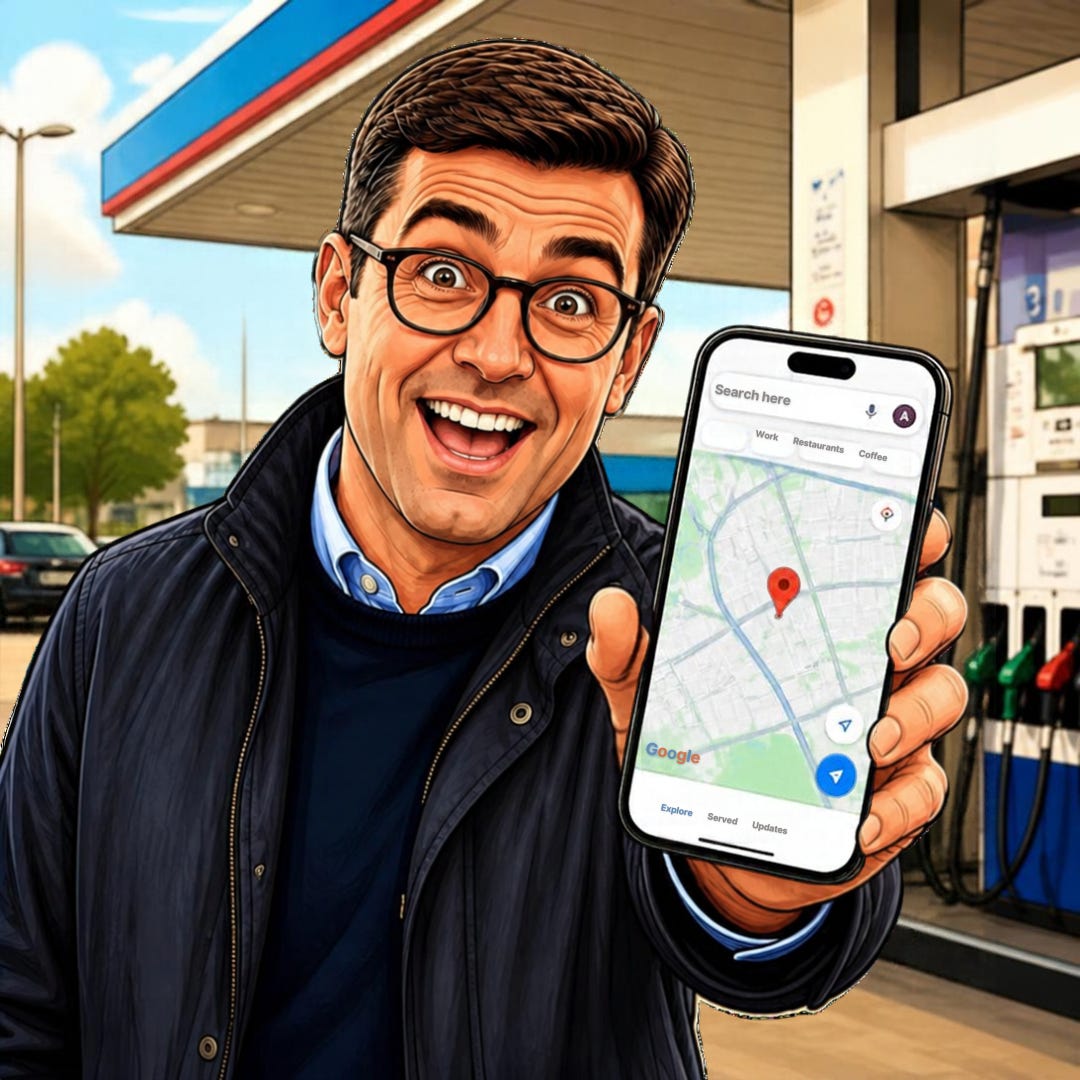
Petrol prices are rising again.
As drivers across Britain watch the numbers climb on forecourt signs, the government has unveiled its latest solution: Google Maps.
This week, ministers celebrated a new feature allowing motorists to compare fuel prices through Google Maps and other apps. The government described it as a way of helping drivers save money by finding cheaper petrol stations. Officials claimed the average motorist could save a whopping £40 a year. That’s almost half a tank of petrol in a standard SUV. Wow!
Want to know how UK motorists took this? Check out the reaction in the comments on Andy Burnham’s own Facebook post: ‘Patronising..’ ‘Out of touch..’ ‘Got to be a joke..’ (And those are the polite ones!)
Petrol is approaching levels not seen for years. Diesel has exceeded £2 per litre in some parts of the country. Household budgets are under pressure. Businesses face rising transport costs. And the government’s answer is essentially: have you tried driving somewhere else?
Are these people serious? Google Maps?!!
This one isn’t about petrol. This is about leadership.
The Short Truth
“Petrol prices are high because of wars and foreign events.”
This is the explanation we hear most often. Choose your excuse from the following:
The war in Iran.
Problems in the Middle East.
Attacks on shipping routes.
Global oil markets.
International instability.
All of these are a factor, just as the volatility of foreign markets have always been a factor. Nothing new there. Oil is a global commodity and Britain cannot isolate itself from world events. Recent tensions around the Strait of Hormuz have pushed oil prices higher across the world.
But there’s a problem with this explanation.
It implies Britain is merely a victim.
Something happens overseas. Prices rise. Government shrugs.
“Nothing can be done” they say.
A politically convenient answer.
The problem is - it’s just not true.
The Structural Truth
Look closely at how politicians talk about petrol prices.
The language is remarkably consistent.
Prices are being “driven by global events” (pun clearly not intended).
Motorists are facing “international pressures.”
Costs are rising because of “external factors.”
Notice what’s missing.
Government policy.
The structure of the conversation encourages people to look abroad for causes and solutions. It frames Britain as a passenger rather than a driver.
Yet more than half the cost of a litre of fuel in Britain comes from taxation. Fuel duty currently stands at 52.95 pence per litre, and VAT is then charged on top of both the fuel itself and the duty. In effect, motorists pay tax on a tax. Depending on fuel prices, government taxes account for roughly 50–55% of what drivers pay at the pump.
Politicians discuss petrol prices as if everyone else is to blame. Half the money goes to them. In other words, they are 50% responsible for the price we pay.
Does it sound like that when they talk about it?
The Personal Truth
What about our own part in this, as the UK public?
We complain about petrol prices while at the same time accept - with reluctance - that we can’t do much about it. We buy the excuses.
If a supermarket suddenly doubled the price of milk because half the money was being collected by Westminster, there would be outrage. Yet when it comes to fuel, many people simply shrug and accept it.
Part of the reason is psychological. The tax is hidden.
Drivers see a single number on a forecourt sign. They don’t see a breakdown showing how much goes to oil producers, refiners, transport companies, retailers and the Treasury.
As a result, frustration is often directed at whoever happens to be easiest to blame that week: oil companies, foreign governments, wars or international markets.
What about an itemised column on all forecourt price boards, showing the amount of tax paid per litre?
Greater transparency, so we can remember who is implicit in this. (But read on. Because there could just be a deeper reason.)
The Long Truth
As I said at the start, the real issue here is not petrol prices.
The real issue is leadership.
Whenever petrol prices rise, governments tell the same story. The causes are external. The pressures are global. The circumstances are difficult. The public is encouraged to understand why things are happening rather than expect them to change.
It’s true that the British prime minister doesn’t control the barrel price of crude oil. No government can single-handedly stop conflicts in the Middle East or stabilise global energy markets.
But leadership is not simply the ability to explain problems. It is the ability to influence outcomes.
Imagine a football manager whose team loses every week. After every defeat he produces a detailed explanation. The referee made mistakes. The weather was poor. The opposition spent more money. Injuries disrupted the squad. Eventually supporters would ask an obvious question: what exactly are you doing about it?
Politics increasingly resembles that manager.
The public is offered explanations instead of solutions.
That is why the Google Maps announcement felt so tone deaf. Nobody objects to price transparency. Being able to find cheaper fuel is useful. But presenting a comparison app as a major response to rising fuel costs risks missing the point entirely (or does it?).
Telling drivers to search for a slightly cheaper petrol station is like telling somebody struggling with rent to shop around for cheaper light bulbs.
It also smacks of smoke and mirrors. (And I don’t mean exhausts and rear-view.)
We don’t want excuses for such problems. We want ownership.
Just think of how many times Keir Starmer blamed the Tory Government for every bad policy move. That was fine for the first six months. But after almost two years, it sounded pathetic - one of the clearest illustrators of the weak leadership which led to his demise.
A strong leader cannot control everything.
But a strong leader does not hide behind everything they cannot control. (Or maybe..?)
Long Solution
Let’s start with greater transparency.
When petrol prices rise, governments should be honest about all the factors involved, including the role played by taxation. If over half of the pump price consists of fuel duty and VAT, that should be part of the conversation rather than a detail hidden in Treasury documents.
The second step is accountability.
If ministers believe current fuel taxes are essential, they should explain why and defend them openly. If they believe drivers need relief, they should be prepared to consider reducing the tax burden rather than acting as though global events are the only relevant factor. But - interestingly - we’re not having this conversation.
Which raises a different - perhaps more plausible - explanation. Maybe there is leadership going on here. Maybe there’s a perfectly good reason why instead of cutting tax on fuel the government simply directs us into more spending:
Andy Burnham has been a champion of public transport, promoting buses and (public-owned) trains at every opportunity. Funny how he seems decidedly less of a champion for the motorist.
He’d never admit it, of course. But in the same way taxing cigarettes helped reduce their popularity, there is every possibility he sees the same strategy in taxing motorists.
Because when he taunts us with poxy non-solutions like Google Maps, isn’t he really just saying - “I don’t care!"
When drivers are paying more than half the cost of every litre to the state, pointing them towards Google Maps does not look like a solution.
It looks like diversionary, unsympathetic taunting from a Prime Minister who increasingly seems more in need of Google Maps than the rest of us.
Have your say! Let me know if you agree:
And if you liked this article, be sure to subscribe to The Long Truth to receive my FREE weekly newsletter. A different life problem solved each week. It’s brilliant!
They only care about their careers, they don't really care about helping people. Modern society is going backwards 😤