

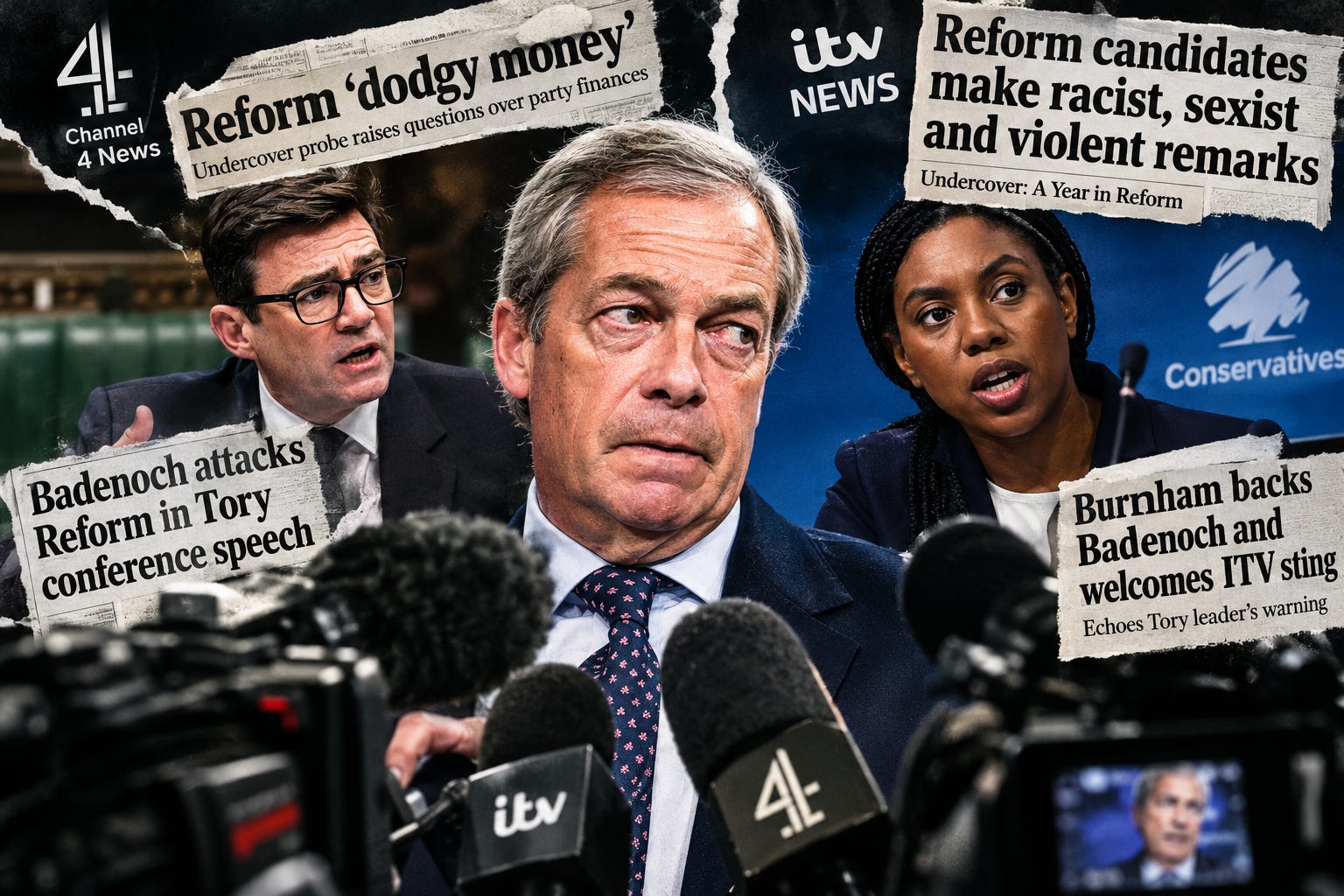
Two undercover stings. Two major broadcasters. One political party in the firing line. And its two biggest political opponents more than ready to pile in.
First came Channel 4’s undercover investigation into Reform UK’s finances. Then ITV’s Undercover: A Year in Reform, exposing candidates and councillors making racist, Islamophobic, sexist and violent remarks.
The Channel 4 footage raised questions about political funding, including discussions involving a purported American donor, polling and arrangements that appeared designed to conceal the source of money. Reform denied wrongdoing, and its internal investigation concluded that the proposed £500,000 donation had not taken place and no laws had been broken.
ITV’s investigation was even more explosive. Candidates and councillors were recorded making appalling remarks about Asian residents, black children, Muslims and immigrants. One described Asian homeowners as “parasites”. Others spoke about forcibly removing people from their homes. The investigation also raised questions about Reform’s candidate vetting and how the party handled allegations of racism internally.
These are serious findings. Nobody should pretend otherwise.
But then came the political encore. Kemi Badenoch cited the controversy in her Conservative Party conference address, using it to attack Reform’s credibility. Days later, Prime Minister Andy Burnham echoed her position in the House of Commons, praising her stance and welcoming ITV’s investigation.
Different parties. Different speeches. Same target. Same political message.
Is this simply the normal process of politicians condemning appalling behaviour? Or are we watching the media and the established parties reinforce one another’s narratives at precisely the moment Reform threatens their grip on power?
Let’s apply the Long Truth Method.
1. Short Truth: The Establishment Is Coming for Reform
Just as Dominic Cummings predicted, Reform is being hammered by the media, and Labour and the Conservatives are making sure nobody misses it.
Channel 4 puts Reform’s finances under the spotlight. ITV exposes racist candidates and questionable internal decision-making. The headlines practically write themselves: dodgy money, racist candidates, incompetent leadership.
What more could a political opponent ask for?
The footage is damaging because some of the behaviour recorded is genuinely disgraceful. Nobody should defend the indefensible simply because they support a political party. But there is a difference between exposing the wrongdoing of a few and framing that wrongdoing as indicative of an entire political party.
When Louise Haigh was convicted of fraud in 2024, nobody claimed that the entire Labour party was guilty of the crime. (She’s back now, of course, like a Mandelsonesque boomerang). Similarly, when recently deceased Tory Lord Jeffrey Archer was imprisoned for perjury in 2001, nobody struggled to separate the individual from his party.
Yet look at the narrative here. Reform top the polls, seemingly unstoppable. Two mainstream media outlets launch smear campaigns clearly intent on digging the dirt. When bad-acting individuals are found within the Reform ranks, these findings are spun by its political opponents as an indictment of the Reform party as a whole.
Two major undercover investigations, followed by the leaders of Labour and the Conservatives reinforcing the same political message. That’s one hell of a news cycle.
Usually at each other’s throats, has anyone noticed how the two parties which have fought over British politics for generations are suddenly engaged in a love-in, united in their condemnation of the party threatening to replace them?
Yet unlike Kemi’s schoolgirl crush on Andy’s eyelashes (give us a break!) or Andy’s ‘I liked your conference speech, Kemi’ note passed to her in class, this ‘Let’s get Nigel’ pile-on is a uni-party collaboration with no light undertones.
Nothing unites people like a common enemy - especially one that threatens to take away their power.
It could be argued that the broadcasters are simply doing their jobs and the politicians are responding to the news. That’s plausible. Suspicious timing is not proof of collusion.
But neither should we stop asking questions just because asking them makes us sound like conspiracy theorists.
Where is the equivalent determination to expose the weaknesses of the established parties? Would Labour or the Conservatives receive the same treatment if they were suddenly the outsiders threatening the political order? Where’s the Green Party expose? Not threatening enough?
The Short Truth is that Reform is under attack. The question is whether it is receiving fair scrutiny or whether the machinery of political respectability is being used to tell voters which party they should fear.
2. Structural Truth: Follow the Timing and the Incentives
Undercover documentaries don’t materialise overnight. They require planning, access, filming, editing and legal checks. ITV’s investigation involved a year of work inside Reform’s political operation.
An MRP poll published in October 2025 placed Reform UK on 36pc, ahead of Labour on 21pc and with the Conservatives trailing on just 15pc. On those figures, Reform was predicted to secure 367 seats with an outright majority of 84, leaving Labour on 117 seats and the Liberal Democrats on 58.
That very same month, the sting operations we are seeing this week would have been commissioned by Channel 4 and ITV.
Curiously suspicious timing, or just coincidence?
Admittedly, once commissioned, an undercover reporter sent to plot the sabotage of Reform would not have needed to look far for subject material. Reform had - maybe still has - two obvious vulnerabilities.
First, money. The Channel 4 sting captured discussions about funding political polling through an arrangement involving a purported American donor. The programme raised questions about transparency and compliance with rules on political donations. The proposed £500,000 donation did not take place, according to Reform’s internal inquiry, so we should not confuse discussions about an arrangement with proof that an illegal donation was completed.
Nevertheless, entertaining questionable arrangements can expose poor judgement even when no offence is ultimately established.
Second, candidates. ITV’s footage revealed individuals who should never have been allowed to represent a serious political party. It also raised questions about how Reform vetted candidates and responded when concerns emerged. The issue is not simply what individual candidates said, but whether the party’s leadership had the systems and determination to deal with them.
Now consider the political sequence. Badenoch uses the controversy to attack Reform. Burnham subsequently echoes her position in Parliament. Labour and the Conservatives may disagree about almost everything else, but here they are unipartying away against the common enemy.
Does this prove they arranged the investigations with the broadcasters? Well… er… Let’s just say no such hard evidence exists.
But a political narrative doesn’t require a secret meeting. Broadcasters publish damaging stories; politicians seize on them; other politicians join in; and before you know it your biggest mutual threat is being battered from all sides.
The Structural Truth is that the incentives align. The media get major stories. Labour gets ammunition against a challenger. The Conservatives get an opportunity to distinguish themselves from a party competing for their voters. Reform is left fighting on two - possibly three - fronts.
You don’t need a conspiracy theory to recognise who benefits.
3. Personal Truth: Reform Has Made Itself an Easy Target
If you support Reform, you might be tempted to dismiss the documentaries as establishment propaganda. Every damaging revelation becomes proof that the system is frightened of you.
But that’s how political loyalty becomes an excuse for incompetence.
The racist remarks captured by ITV don’t become acceptable because Labour and the Conservatives are exploiting them. Questionable financial arrangements don’t become respectable because Channel 4 investigated them. Nobody is defending Reform here.
Some of the footage is genuinely shocking. Describing Asian residents as parasites or making grotesque remarks about black children isn’t simply a politician being caught in an awkward conversation. It raises serious questions about the individuals involved and the judgement of the organisation that selected them.
The internal footage may be even more damaging. A party can remove an unsuitable candidate. It is much harder to explain footage suggesting that officials recognised a problem but struggled to deal with it decisively.
Nigel Farage cannot personally predict everything every candidate might say. Nobody can. But vetting isn’t about reading minds. It’s about checking records, examining public statements and acting when credible concerns emerge.
The same applies to money. A party demanding public trust must maintain proper financial controls and transparent arrangements.
Reform’s political appeal rests partly on the claim that the established parties are incompetent, out of touch and incapable of delivering change. Yet its own failures give those parties precisely the ammunition they need.
The Personal Truth is uncomfortable: Reform may be facing hostile coverage, but it has also made that coverage possible. It cannot control what journalists investigate. It can control who represents it, how it handles money and whether it deals with problems before they become national scandals.
If it wants to be treated as a government-in-waiting, it needs to do much better than that and to start acting like one.
4. Long Truth: The Establishment Is Rattled
Forget the conspiracy theories. You don’t need to imagine secret meetings between politicians and television executives to understand what’s happening. The more interesting point is that the establishment is rattled — and when the establishment feels threatened, protecting the status quo takes priority over impartiality.
Brexit taught us something big about this. The political establishment didn’t want it. Much of the media didn’t want it. Yet the British public voted for it anyway. An outcome that the political class considered unacceptable slipped through its fingers, despite years of argument, warnings and attempts to persuade voters otherwise.
The establishment never really came to terms with that result. Brexit wasn’t simply a policy disagreement. It was a demonstration that the public could reject the consensus of politicians, commentators and institutions that assumed they knew best.
Now comes Reform, promising another challenge to the established political order. And the stakes are potentially even higher. This isn’t just about leaving the EU; it’s about who governs Britain, who sets the political agenda and whether voters are prepared to abandon the two parties that have dominated Westminster for generations.
Is it really surprising that the establishment is nervous?
The Long Truth is that these stings aren’t just about what Reform has done wrong. They’re also about what happens when a political establishment, already burned by Brexit, sees another threat to the status quo. The public deserves the truth about Reform — but it deserves an impartial media, too.
5. Long Solution: Reform Must Reform Itself
The British public is fed up with the old political choices. That frustration has been built over years of disappointment about immigration, the cost of living, public services, housing and a political class that repeatedly promises to fix problems it has failed to solve.
Labour and the Conservatives cannot expect voters to forget their records simply because Reform has had a bad week.
Because bad week or not, Reform continues to offer a serious alternative. By placing immigration, living costs, reform of the NHS and the benefits system front and centre, it still carries the hope of many voters - a hope that the established parties seem to have abandoned. That remains a genuine - albeit dented - opportunity.
Twelve months ago, the tide felt like it had already turned - perhaps for good. Fast forward to now and, after a barrage of media-driven reputational damage, Reform are now behind Labour and not much ahead of the Tories.
Reform clearly needs rigorous candidate vetting, transparent financial arrangements and decisive action when misconduct is established. It must listen to the criticism and act on it unequivocally. Remove the rotten apples, and stop giving the media such easy targets.
The media have responsibilities too. They should investigate Reform, but apply the same standards to Labour and the Conservatives. They should distinguish allegations from established facts and be prepared to explain their editorial decisions.
And voters must resist two comforting fictions: that Reform is the innocent victim of a grand conspiracy, or that the established parties have suddenly become guardians of political decency.
The documentaries may expose real problems. The coverage may benefit the establishment. Labour and the Conservatives may be right to condemn what they have seen while still having plenty to explain about their own records.
Britain needs a credible alternative, not merely a different set of people making the same mistakes.
Reform has identified a real problem: millions of voters no longer trust the political class to deliver the changes they want. But if it wants those voters to trust it with power, it must prove that it can govern itself, manage its money, select its people and deliver on its promises.
The reminder to do so given by these two stings may just be the kick in the arse they needed to smarten up their act and become more electable.
The British public is still looking for a solution. Reform may be right to challenge the establishment, but before it can reform Britain, it must reform itself. Otherwise, the establishment won’t need to stop it. Reform will do the job for them.